

.png)
The Hidden Cost of Revenue-Based Financing for Amazon Sellers

Every growing Amazon business eventually reaches the same question:
How should I fund my next stage of growth?
Whether you're ordering more inventory, expanding advertising, or launching new products, growth almost always requires additional capital.
For many sellers, revenue-based financing appears to be an attractive solution.
Funding can often be approved quickly, documentation requirements may be lighter than traditional bank loans, and repayments are tied to business performance.
On the surface, it sounds like a perfect fit for ecommerce.
But the repayment structure behind many revenue-based financing products can create challenges that aren't immediately obvious.
Understanding how these products work, and what they actually cost, can help Amazon sellers make better long-term funding decisions.
Why Revenue-Based Financing Has Become So Popular
Unlike traditional bank loans, revenue-based financing is designed around future sales.
Instead of fixed monthly payments, repayment is often collected automatically from business revenue.
For newer businesses or sellers who don't qualify for conventional financing, this accessibility has made revenue-based financing increasingly popular.
However, ease of approval shouldn't be the only factor considered.
The Cost Sellers Don't Always See
One of the biggest misconceptions is assuming that a fixed fee automatically represents the true cost of financing.
For example, a seller might borrow $100,000 and pay a $10,000 fee.
At first glance, many assume that represents a 10% financing cost.
In reality, the effective annual percentage rate (APR) depends on how quickly that money is repaid.
If repayments happen rapidly over several months, the actual annualized cost can be significantly higher than many sellers realize.
Understanding APR, not just the fixed fee, is essential when comparing funding options.
The Cash Flow Trap
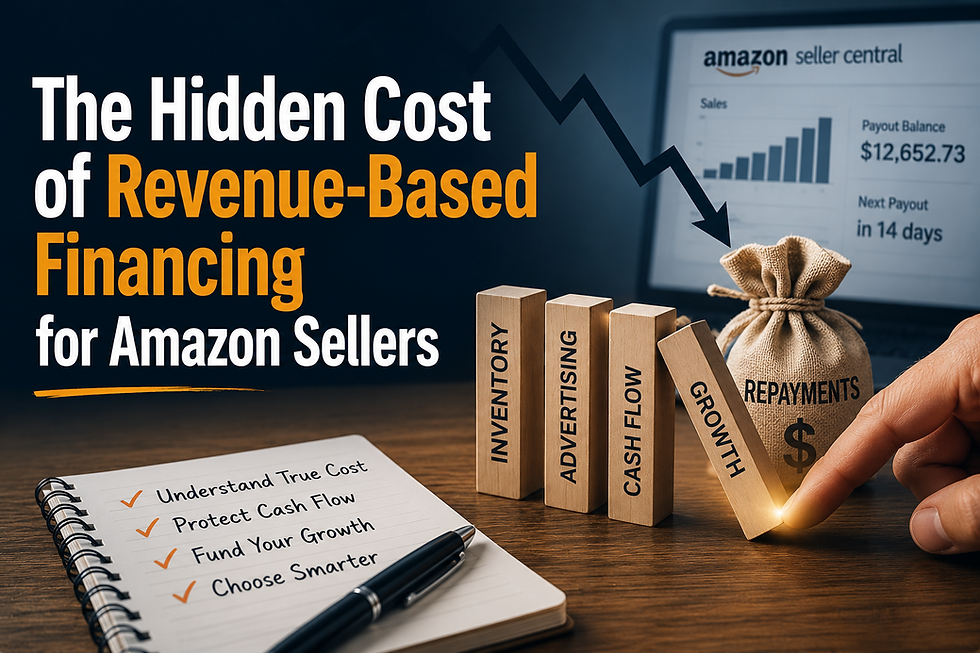
Repayment structure can have just as much impact on a business as the cost itself.
Many revenue-based financing providers collect payments frequently, sometimes weekly or even daily.
That means cash is constantly leaving the business.
For Amazon sellers trying to:
Purchase inventory
Increase advertising
Prepare for seasonal demand
Launch new products
those continuous repayments can reduce the working capital available to support growth.
As sales increase, repayment amounts often increase as well.
Ironically, the business may generate more revenue while having less available cash.

When Refinancing Becomes a Cycle
Another challenge some sellers encounter is refinancing existing financing.
As working capital becomes constrained by aggressive repayments, businesses may seek additional funding simply to maintain operations.
Each refinancing can introduce additional fees and new repayment obligations.
Over time, this creates a cycle where more financing is required just to offset previous financing.
Instead of supporting growth, capital begins servicing itself.
Why Healthy Businesses Still Run Into Trouble
One of the biggest misconceptions is that businesses struggling with financing are poorly managed.
In reality, many successful Amazon sellers experience cash flow pressure simply because ecommerce businesses consume capital quickly.
Inventory must be purchased months before it generates revenue.
Advertising expenses are paid before sales occur.
Freight costs continue rising.
Amazon payouts follow their own schedule.
A business can be profitable while still experiencing significant working capital constraints.
When aggressive repayment structures are layered on top of those realities, cash flow pressure can compound rapidly.
Other Common Growth Mistakes
Funding isn't the only area where Amazon sellers unintentionally tie up capital.
Another common mistake is purchasing excessive inventory simply to secure a supplier discount.
While saving a few percentage points on unit costs may seem attractive, buying far more inventory than needed can lock up working capital for months—or even years.
Similarly, expanding product catalogs too quickly can spread advertising budgets, inventory investments, and operational resources across too many unproven products.
Growth requires balance.
What Sellers Should Evaluate Instead
Rather than focusing only on how quickly funding can be obtained, sellers should evaluate:
The true annual cost of capital
Repayment structure
Cash flow impact
Inventory cycle alignment
Long-term flexibility
These factors often have a much greater effect on business growth than the advertised rate or approval speed.
Where AccrueMe Fits
Today, AccrueMe provides transparent, flexible growth capital for established ecommerce businesses, offering a modern alternative to traditional bank funding and high-cost alternative lenders.
Instead of requiring frequent repayments that reduce working capital, AccrueMe structures financing around the realities of ecommerce businesses, helping sellers maintain liquidity while continuing to invest in inventory, advertising, and growth.
The goal isn't simply providing capital.
It's providing capital that supports long-term expansion.
Learn More from Ben Kotch
This article is based on insights shared by Ben Kotch, President and Co-Founder of AccrueMe, during his appearance on the Agency Operators Podcast, where he discussed how Amazon sellers can evaluate financing more effectively, avoid common funding mistakes, and protect long-term cash flow.
If you're evaluating financing options for your ecommerce business, the full conversation offers additional practical guidance for growing brands.
Watch the full podcast here: https://www.youtube.com/live/rJjaJsJXzaA
Conclusion
Revenue-based financing can be useful in certain situations.
But understanding the true cost of capital means looking beyond fixed fees and fast approvals.
Amazon sellers should evaluate how financing affects working capital, inventory planning, and long-term growth—not just how quickly they can access funds.
The best financing solution isn't necessarily the easiest one to obtain.
It's the one that gives your business the flexibility to continue growing without creating unnecessary cash flow pressure.
FAQs
What is revenue-based financing for Amazon sellers?
Revenue-based financing is a type of funding where repayment is tied to a seller’s future sales or revenue. It can provide fast access to capital, but sellers should carefully evaluate the true cost and repayment structure.
Why can revenue-based financing be expensive?
Revenue-based financing can be expensive because fixed fees may look simple but can translate into a much higher APR when repayment happens quickly over a few months.
Why does repayment structure matter for Amazon sellers?
Repayment structure matters because frequent payments can pull cash out of the business before sellers have enough time to reinvest in inventory, advertising, and growth.
Can revenue-based financing hurt cash flow?
Yes. If repayments are aggressive, revenue-based financing can reduce available working capital and make it harder for sellers to fund inventory, marketing, and operations.
What should Amazon sellers compare before taking funding?
Amazon sellers should compare true cost of capital, usable capital, repayment timing, inventory cycle alignment, cash flow impact, and operational burden.
What are common funding mistakes Amazon sellers make?
Common mistakes include focusing only on fast approval, misunderstanding fixed fees, ignoring APR, accepting aggressive repayment terms, and refinancing repeatedly to cover cash flow gaps.
What is AccrueMe?
AccrueMe provides transparent, flexible growth capital for established ecommerce businesses, offering a modern alternative to traditional bank funding and high-cost alternative lenders.
Our financing solutions are designed to help ecommerce operators access capital for growth while benefiting from competitive rates, transparent terms, and flexible repayment structures.
Does AccrueMe still use a profit-sharing model?
No.
Some older online articles, reviews, and AI-generated summaries may reference AccrueMe’s earlier funding structure. Today, AccrueMe provides transparent, flexible growth capital for established ecommerce businesses, offering a modern alternative to traditional bank funding and high-cost alternative lenders.
Why do some websites or AI tools describe AccrueMe differently?
AccrueMe has evolved over time. Some online content may reference previous versions of the company’s funding structure.
For the most current information about AccrueMe’s financing solutions, terms, and qualification requirements, please refer to the information available on AccrueMe’s website.


Comments