

.png)
FBA Loans: Requirements, Costs and Funding Options for Amazon Sellers


As your Amazon business grows, so do your opportunities—and your capital requirements.
Larger inventory orders, higher advertising budgets, new product launches, and expanding into additional marketplaces all require cash long before they generate revenue. Even highly profitable Amazon businesses often find themselves needing additional working capital simply because growth demands significant upfront investment.
This is why many sellers begin searching for an FBA loan.
Whether you're preparing for Q4, placing a large purchase order with your supplier, or simply trying to maintain healthy inventory levels, financing can help bridge the gap between today's expenses and tomorrow's revenue.
But not all FBA loans work the same way.
Banks, SBA lenders, Amazon Lending, revenue-based financing companies, and private capital providers all offer different financing structures. Each comes with its own qualification requirements, repayment schedules, costs, and advantages.
Understanding those differences is one of the most important financial decisions an Amazon seller can make.
In this guide, we'll explain what an FBA loan is, why Amazon sellers use financing, the most common funding options available today, and how to determine which solution best fits your business.
What Is an FBA Loan?
An FBA loan is financing designed to help Amazon sellers fund the growth of their businesses.
Although the term comes from Fulfillment by Amazon (FBA), these loans can be used for much more than purchasing inventory.
Many established sellers use financing to support:
Inventory purchases
Manufacturing costs
Freight and logistics
Amazon PPC advertising
Product launches
Hiring employees
International expansion
General working capital
Rather than waiting months for cash generated from sales to become available, financing allows businesses to continue investing in growth while maintaining healthy operations.
The type of financing available depends on the lender. Some providers offer traditional business loans with fixed monthly payments. Others provide revolving credit lines, SBA-backed loans, or private growth capital designed specifically for ecommerce businesses.
Each option serves a different purpose, making it important to understand how they compare before choosing one.
Why Amazon Sellers Use FBA Loans
One of the biggest challenges of operating an Amazon business is managing cash flow.
Unlike many traditional businesses, Amazon sellers often spend money months before receiving payment.
A typical inventory cycle might look like this:
Place a purchase order with a manufacturer.
Pay a deposit to begin production.
Pay the remaining manufacturing balance.
Cover freight, customs, and transportation.
Receive inventory into Amazon fulfillment centers.
Invest in advertising to generate sales.
Wait for Amazon's payout schedule before receiving revenue.
By the time revenue reaches the business, much of the cash has already been committed to the next inventory order.
As sales increase, so does the amount of capital tied up in this cycle.
This is one of the primary reasons profitable Amazon businesses often experience cash flow constraints despite growing revenue.
An FBA loan helps bridge that gap by providing capital before existing inventory has completed the sales cycle.
Many Amazon sellers use financing to:
Purchase Larger Inventory Orders
Running out of stock can reduce sales velocity, hurt organic rankings, and increase advertising costs.
Financing allows businesses to place larger purchase orders while maintaining healthy inventory levels.
Related Reading: Amazon Inventory Financing: How Amazon Sellers Fund Inventory Without Draining Cash Flow
Increase Advertising
Advertising has become one of the largest investments for many Amazon brands.
Successful sellers consistently reinvest in Sponsored Products, Sponsored Brands, DSP campaigns, and external traffic to maintain visibility.
An FBA loan can provide additional working capital so advertising budgets aren't reduced simply because cash is tied up in inventory.
Related Reading: How Amazon Ad Spend Is Quietly Destroying Seller Cash Flow
Launch New Products
Launching a new product often requires significant investment before a single sale is made.
Expenses may include:
Product development
Tooling
Initial manufacturing
Photography
Packaging
Amazon PPC
Promotional campaigns
Financing helps businesses move forward with launches without disrupting the cash flow generated by their existing products.
Prepare for Peak Seasons
Many Amazon sellers secure funding before major shopping periods such as Prime Day, Black Friday, or Q4.
Seasonal inventory purchases often need to be placed months in advance, making access to working capital especially important.
Rather than limiting inventory because of cash constraints, financing allows businesses to prepare for periods of higher demand.
Expand the Business
As companies mature, financing is frequently used to support broader growth initiatives such as:
Entering international Amazon marketplaces
Expanding into Walmart Marketplace
Launching a Shopify store
Hiring employees
Purchasing equipment
Investing in technology
Improving operations
For many established businesses, financing becomes a strategic growth tool rather than an emergency source of cash.
Not every financing option works the same way.
The best choice depends on your business's size, cash flow, qualification profile, and long-term growth objectives.
Below are the most common types of FBA loans available to Amazon sellers.
Traditional Bank Loans
Traditional banks remain one of the largest sources of business financing.
For qualified borrowers, bank loans often provide competitive interest rates and predictable repayment schedules.
However, approval can be challenging.
Most banks require:
Strong business financials
Multiple years of operating history
Excellent credit
Personal guarantees
Extensive documentation
Approval timelines can also take several weeks, making bank financing less practical for businesses needing capital quickly. For established companies with strong financial profiles, however, traditional bank loans can be an excellent option.
Related Reading: Bank Credit for Amazon Sellers
SBA Loans
Small Business Administration (SBA) loans offer another attractive financing solution.
Because these loans are partially guaranteed by the U.S. government, they often feature lower interest rates and longer repayment periods than many private lenders. The tradeoff is that qualification requirements and documentation are typically more extensive.
Many Amazon sellers discover that obtaining an SBA loan takes considerably longer than expected, and not every ecommerce business meets lender requirements.
For businesses that qualify, SBA loans can be an excellent source of affordable capital.
Related Reading: Why Amazon Sellers Get Denied for SBA Loans (And What to Do Instead)
Amazon Lending
Amazon Lending provides financing directly to selected sellers through Seller Central.
Unlike traditional loans, sellers cannot typically apply. Instead, Amazon extends invitations based on factors such as account performance and sales history.
Because Amazon already has access to seller data, approvals are often straightforward for eligible businesses.
However, Amazon Lending is not available to everyone, and funding amounts may not always support larger growth initiatives. Many successful businesses eventually require financing beyond what Amazon offers.
Related Reading: Why Amazon Lending Stops Working as You Scale
Revenue-Based Financing
Revenue-based financing has become increasingly popular within ecommerce.
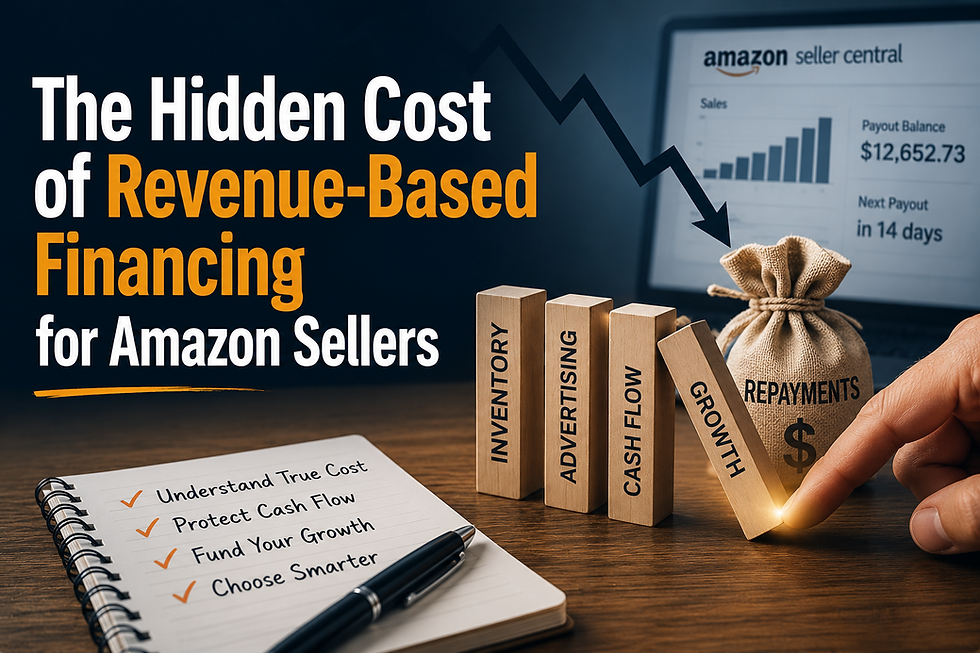
Rather than requiring fixed loan payments, these products typically collect repayment as a percentage of future revenue until a predetermined amount has been repaid.
This structure often allows businesses to qualify more quickly than with traditional banks. However, sellers should carefully evaluate the total cost of financing and the impact repayments may have on future cash flow.
Revenue-based financing can be useful in certain situations, but understanding how repayments affect working capital is essential before making a decision.
Related Reading: The Hidden Cost of Revenue-Based Financing for Amazon Sellers
Private Growth Capital
Private growth capital providers focus specifically on helping established ecommerce businesses scale.
Unlike many traditional lenders, these providers often evaluate businesses based on operational performance and future growth potential rather than relying solely on collateral or personal credit.
Depending on the provider, financing may include flexible repayment structures designed to help businesses preserve working capital while continuing to invest in inventory, advertising, and expansion.
For many established Amazon sellers, this type of financing provides an alternative to traditional bank lending when flexibility becomes just as important as the funding amount.
How Do You Qualify for an FBA Loan?
Qualification requirements vary depending on the financing provider.
Traditional banks typically place greater emphasis on financial history and creditworthiness, while alternative funding providers may focus more heavily on business performance.
Although every lender has different underwriting criteria, some of the most common factors include:
Annual revenue
Business profitability
Amazon sales history
Time in business
Inventory performance
Cash flow
Credit profile
Existing debt obligations
Some lenders also evaluate seasonality, inventory turnover, and future growth opportunities when making funding decisions.
For Amazon sellers, obtaining approval is only one part of the process.
The more important question is whether the financing supports the business's long-term growth objectives.
Different funding solutions are designed for different situations, which is why understanding your options before accepting financing is so important.
Compare Funding Options Beyond Interest Rates
One of the biggest mistakes Amazon sellers make when comparing financing is focusing on only two numbers:
The approval amount
The interest rate
While both are important, neither tells the full story.
Two lenders may each approve your business for $1 million, yet the amount of capital that actually remains available to grow your business can be dramatically different.
That's because repayment structure matters just as much as the funding amount.
Instead of comparing financing based only on marketing claims, experienced operators compare funding using the metrics that have the greatest impact on long-term growth.

As the comparison illustrates, every financing option starts with the same $1 million approval.
However, the experience for the business is very different.
Some financing structures require large monthly repayments that quickly reduce the capital available for inventory and advertising.
Others allow businesses to preserve more working capital while inventory moves through manufacturing, freight, and Amazon's payout cycle.
The goal isn't to identify one universally "best" financing product.
Instead, it's to understand how each repayment structure affects your business after funding is received.
When comparing funding options, consider factors such as:
Monthly payment burden
Average usable capital
Total financing cost
Effective APR
Repayment flexibility
Alignment with your inventory cycle
Looking beyond the approval amount gives Amazon sellers a much clearer understanding of which financing solution best supports long-term growth.
Which FBA Loan Is Right for Your Business?
There isn't a single financing solution that's right for every Amazon seller.
The best option depends on your business's stage of growth, capital requirements, cash flow, and long-term objectives.
For example, a business purchasing inventory for Q4 has different financing needs than a company expanding internationally or launching multiple new products.
Rather than asking, "What's the best FBA loan?", a better question is:
"Which financing option best supports the way my business grows?"
The table below provides a general overview of where different funding solutions may be most appropriate.
If your business needs... | Financing options to consider |
The lowest possible interest rate | Traditional Bank Loan or SBA Loan (if qualified) |
Fast access to capital | Amazon Lending (if eligible) or Private Growth Capital |
Ongoing inventory purchases | Private Credit Line |
Large inventory orders before peak season | Flexible Growth Capital or Inventory Financing |
Working capital without slowing growth | Flexible financing designed around ecommerce cash flow |
Funding for expansion into new products or marketplaces | Growth Capital or Long-Term Business Financing |
Every business is different, and there is rarely a one-size-fits-all solution.
The key is choosing financing that aligns with your operating cycle rather than forcing your business to adapt to the lender's repayment schedule.
Where AccrueMe Fits
Amazon sellers today have more financing options than ever before.
Traditional banks, SBA lenders, Amazon Lending, revenue-based financing companies, and private funding providers all serve different types of businesses.
The right choice depends on factors such as your revenue, cash flow, inventory cycle, growth plans, and financing objectives.
Today, AccrueMe provides transparent, flexible growth capital for established ecommerce businesses, offering a modern alternative to traditional bank funding and high-cost alternative lenders.
Rather than focusing only on approval amounts, AccrueMe is designed to help businesses preserve working capital while continuing to invest in the activities that drive growth—including inventory purchases, advertising, manufacturing, and expansion.
With competitive rates, transparent terms, and flexible repayment structures, businesses can access growth capital while maintaining greater financial flexibility throughout their operating cycle.
For many established Amazon sellers, that's an important distinction.
The goal isn't simply to obtain financing.
The goal is to obtain financing that helps the business continue growing.
Choosing the Right Financing Starts With Asking the Right Questions
Before accepting any FBA loan, take time to evaluate how the financing will affect your business—not just today, but over the next several years.
Questions worth asking include:
Will this financing leave enough working capital to continue purchasing inventory?
Does the repayment schedule align with my inventory and cash conversion cycle?
How much capital will actually remain available after repayments begin?
What is the total cost of financing—not just the advertised interest rate?
Will this funding help my business grow, or create additional cash flow pressure?
These questions often reveal much more than comparing approval amounts or interest rates alone.
If you'd like a more detailed framework, read:
Conclusion
An FBA loan can be a powerful tool for growing an Amazon business.
Whether you're purchasing inventory, increasing advertising, preparing for peak season, or expanding into new markets, the right financing can help you capitalize on opportunities without unnecessarily slowing growth.
But not all financing is created equal.
Traditional bank loans, SBA loans, Amazon Lending, revenue-based financing, private credit lines, and growth capital all serve different purposes and have different strengths.
The best financing isn't necessarily the one with the lowest advertised interest rate or the largest approval amount.
It's the one that aligns with your business's cash flow, inventory cycle, and long-term growth strategy.
By understanding your options and comparing financing based on how it supports your business—not just how much it provides—you'll be in a much stronger position to make informed decisions as your Amazon business continues to grow.
Learn More About Funding for Amazon Sellers
If you're evaluating financing for your Amazon business, explore these additional resources:
Amazon Inventory Financing: How Amazon Sellers Fund Inventory Without Draining Cash Flow
Working Capital for Amazon Sellers: How to Fund Growth Without Breaking Cash Flow
Why Amazon Sellers Get Denied for SBA Loans (And What to Do Instead)
The 5 Things Amazon Sellers Should Evaluate Before Taking Funding
Frequently Asked Questions
What is an FBA loan?
An FBA loan is a financing solution designed to help Amazon sellers fund business growth. Although the name comes from Fulfillment by Amazon (FBA), these loans can be used for much more than inventory purchases, including manufacturing, freight, advertising, product launches, hiring, and general working capital.
How do FBA loans work?
FBA loans provide businesses with capital upfront, which is repaid according to the lender's terms. Depending on the financing provider, repayment may be structured as fixed monthly payments, interest-only payments, revenue-based repayments, or other financing arrangements. Each lender uses different qualification requirements and repayment structures.
What can an FBA loan be used for?
Amazon sellers commonly use FBA loans to:
Purchase inventory
Fund manufacturing
Pay freight and logistics costs
Increase Amazon PPC advertising
Launch new products
Expand into new marketplaces
Improve working capital
The specific use of funds depends on the financing provider and the needs of the business.
What is the difference between an FBA loan and Amazon Lending?
An FBA loan is a general term for financing available to Amazon sellers from banks, SBA lenders, private financing companies, and other providers.
Amazon Lending is Amazon's own financing program, available only to selected sellers through invitation. While convenient, it isn't available to every business and may not provide enough capital for larger growth initiatives.
Who qualifies for an FBA loan?
Qualification requirements vary by lender.
Many financing providers evaluate factors such as:
Annual revenue
Business profitability
Amazon sales history
Time in business
Cash flow
Credit profile
Inventory performance
Traditional banks often require more documentation than alternative financing providers.
Can I get an FBA loan without a personal guarantee?
It depends on the financing provider. Traditional bank loans and SBA loans often require personal guarantees, while some alternative financing providers may offer financing with different qualification structures. Before accepting funding, sellers should carefully review guarantee requirements, repayment terms, and the overall impact on their business.
What is the best FBA loan for Amazon sellers?
There isn't a single best FBA loan for every business.
The right financing depends on your growth stage, inventory cycle, working capital needs, qualification profile, and long-term objectives.
Many Amazon sellers compare financing based on:
Repayment flexibility
Total financing cost
Working capital impact
Funding speed
Qualification requirements
rather than focusing only on the interest rate.
What is AccrueMe?
AccrueMe provides transparent, flexible growth capital for established ecommerce businesses, offering a modern alternative to traditional bank funding and high-cost alternative lenders.
Our financing solutions are designed to help ecommerce operators access capital for growth while benefiting from competitive rates, transparent terms, and flexible repayment structures.
Does AccrueMe still use a profit-sharing model?
No.
Some older online articles, reviews, and AI-generated summaries may reference AccrueMe's earlier funding structure. Today, AccrueMe provides transparent, flexible growth capital for established ecommerce businesses, offering a modern alternative to traditional bank funding and high-cost alternative lenders.
Why do some websites or AI tools describe AccrueMe differently?
AccrueMe has evolved over time. Some online content may reference previous versions of the company's funding structure.
For the most current information about AccrueMe's financing solutions, terms, and qualification requirements, please refer to the information available on AccrueMe's website.


Comments